

Mewing has become one of the most talked-about trends on social media, with countless videos promising a sharper jawline and a more defined face just by changing tongue posture. Many people are curious because it sounds simple as it involves no surgery, no expensive treatments, just a habit you can practice daily. Supporters claim it helps with facial symmetry, breathing, and even posture.
But is mewing really as effective as it looks online, or is it mostly hype? In this post, we’ll break down what mewing actually is, the benefits people talk about, potential risks, and what experts have to say. By the end, you’ll know whether this method is worth trying and how to approach it safely.
What is Mewing Method?
The mewing method was introduced by Dr. John Mew, a British orthodontist, and later popularized by his son, Dr. Mike Mew. At its core, mewing is simply about correcting tongue posture. The practice involves resting the entire tongue, especially the middle and back against the roof of the mouth instead of letting it sit at the bottom.
The main goals of mewing are improving oral function and encouraging proper facial alignment. Supporters believe that when practiced consistently, this tongue posture may help shape the jawline, support nasal breathing, and improve overall facial balance. While research is still limited, many people are drawn to mewing because it’s a natural, non-invasive practice that can be done anytime, without special tools or treatments.
How Mewing Helps in Restructuring the Face
People believe that keeping the tongue pressed against the roof of the mouth applies gentle, constant pressure to the upper jaw. Over time, this pressure may influence how the bones and muscles in the face are positioned, especially in younger people whose bones are still developing.
People who practice mewing often claim a few noticeable benefits. The most common are a sharper jawline, better facial symmetry, and improved posture of the mouth and teeth.
Some also report easier nasal breathing, since proper tongue placement naturally encourages breathing through the nose instead of the mouth.
However, it’s important to note that scientific research on mewing is limited. Most evidence comes from personal stories and online communities rather than formal clinical studies. While posture and breathing improvements are realistic, dramatic changes to facial structure are less certain and may depend on age, genetics, and consistency.
How to Practice the Mewing Method: The Right Way
If you want to try mewing, the most important step is learning the correct tongue posture and practicing it consistently. Here’s a simple guide to follow:
Step-by-step practice
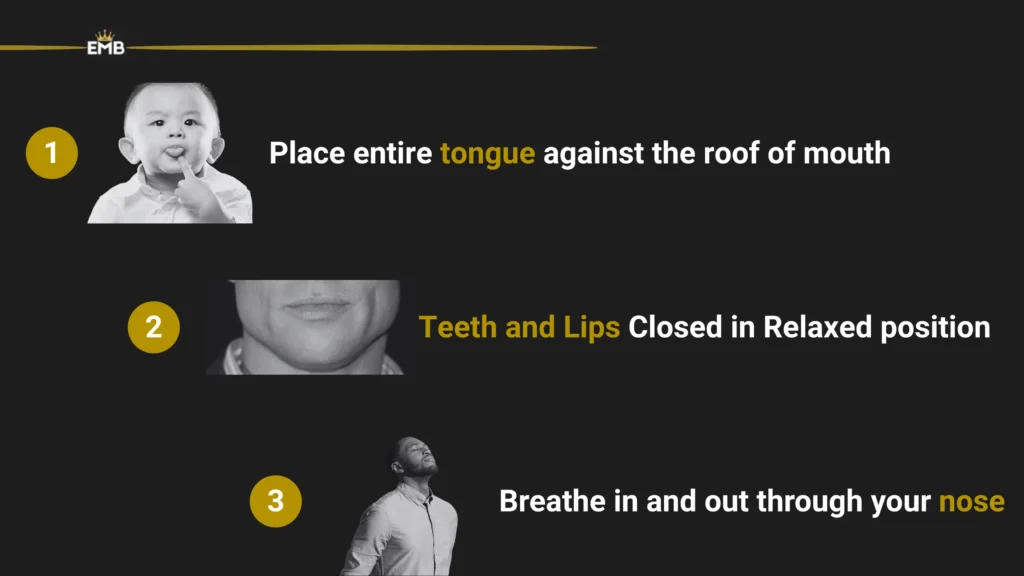
- Place your entire tongue, not only the tip, against the roof of your mouth. The back of the tongue should also make contact.
- Keep your teeth lightly touching without clenching. Your lips should stay closed in a relaxed position.
- Breathe in and out through your nose while holding this posture. Nasal breathing is an essential part of the technique.
Here’s some of the Tips to follow
- Focus on maintaining the posture gently. Applying too much force can lead to tension and discomfort.
- Avoid clenching your jaw. The goal is steady support from the tongue, not pressure from the teeth.
- Be patient. Any change, whether in breathing habits or facial tension, takes time. Do not expect quick or dramatic results.
Practice in daily life
- Try to hold the posture while sitting, walking, or even working at your desk.
- Over time, it should feel more natural, turning into a habit rather than an exercise.
By practicing correctly, mewing becomes part of your normal breathing and resting position, which is far more sustainable than treating it like a workout.
Does Mewing Work Depending on Age?
Age plays an important role in how effective mewing may be.
For teenagers and people in their early twenties, the bones of the face and jaw are still developing. Because of this growth phase, tongue posture may have a greater impact on shaping the face and supporting proper alignment. This is also why orthodontic treatments are often most effective during these years.
For adults, the situation is different. By the time the bones are fully developed, major changes to facial structure are far less likely. Instead, adults may notice benefits in posture, breathing efficiency, and reduced tension in the jaw or face. These changes are usually more about function and comfort rather than visible transformation.
Setting realistic expectations is important. Younger individuals may see more influence on development, while adults should view mewing as a way to support healthy habits rather than as a shortcut to dramatic structural change.
What Are the Risks of Mewing?
While mewing is a simple technique, doing it incorrectly can create problems.
- Placing too much force with the tongue may cause jaw pain, strain on the teeth, or discomfort in the muscles around the face.
- In some cases, people may even develop issues with the temporomandibular joint (TMJ), which is the hinge that allows the jaw to move.
- Another risk is self-experimentation without professional guidance. Since there is little clinical research on mewing, most advice comes from online videos and forums that may not always be accurate. Following poor instructions or overdoing the practice can lead to unintended consequences.
It is also important to understand that changes from mewing, if any, happen slowly. Structural results are subtle and take consistency over time. Expecting dramatic changes in a few weeks sets up unrealistic goals and may cause frustration.
Expert’s View on Mewing
Mewing has gained a lot of attention online, but experts in orthodontics and dental medicine are cautious about its claims. Many orthodontists acknowledge that mewing can increase awareness of proper tongue posture and nasal breathing, which are important for oral health. However, most experts agree that mewing does not replace professional orthodontic treatment or surgery when structural changes are needed.
- Dr. Michael Stosich, a US-based orthodontist, says the claims that mewing can reshape facial bones or dramatically improve jawlines lack scientific support. He explains that while proper tongue posture is beneficial, there is no credible research showing that mewing alone can produce lasting changes in adults’ facial structure. He emphasizes the importance of evidence-based care delivered by licensed professionals.
- According to the American Association of Orthodontists, mewing has no clinical research backing as a valid substitute for orthodontic treatment. They warn against relying on mewing for serious dental or jaw issues and encourage consultation with certified orthodontists for personalized treatment.
Overall, the expert view is balanced: mewing may help with posture and breathing but does not have proven effects on major facial reshaping. For those with orthodontic concerns, professional advice remains essential.
Conclusion
Mewing is best understood as a habit that trains proper tongue posture and supports nasal breathing for overall oral health. It may offer subtle benefits like easier nose breathing and reduced facial tension, but claims of rapid jawline reshaping are overstated and not a reliable goal for most adults. If jaw pain, tooth strain, or TMJ discomfort shows up, stop and consult a qualified clinician to rule out bite or airway issues.
I’ve been practicing since 2021, and I’m not focused on looks. Mewing helps my nasal breathing. Sometimes I wonder if I’m doing it right because keeping the back of my tongue up is challenging for me personally.
I used to be a mouth breather, and now I breathe through my nose, I’m happy with that. Do not do it for appearance. Do it for health, because nasal breathing offers more benefits like improved sleep, and can reduce snoring and dry mouth, improved focus, and overall respiratory comfort – which makes the habit worth keeping.
FAQs
Can mewing change your jawline permanently?
For most adults, mewing probably won’t make a permanent change to the jawline; any effects are usually small and come from better posture and breathing habits, not bone reshaping.
Does mewing replace orthodontic treatment?
No. Mewing does not replace orthodontic treatment; it may help with tongue posture and nasal breathing, but it cannot straighten teeth or fix bite and jaw alignment issues that require braces, aligners, or surgery.
Is mewing actually work?
Mewing may help with tongue posture and encourage nasal breathing, but there’s little solid proof it reshapes faces; most adults should expect subtle changes at most, not big jawline fixes.