

In the age of TikTok transformations and Instagram “before-and-after” shots, few beauty trends have generated as much buzz as mewing. The practice, which claims to enhance jawline definition simply by changing the way you rest your tongue, has captivated millions from teenagers chasing a chiseled profile to adults curious about non-surgical facial improvements.
At its core, this trend revolves around tongue posture the way your tongue rests in your mouth when you’re not speaking or eating. It’s led many to ask the question: Can tongue posture improve jawline? Proponents believe that maintaining the tongue in a certain position can subtly shape the jawline, improve facial balance, and even support better breathing.
But does the science back it up? This blog will dig beneath the hype to explore what proper tongue posture actually is, how it may influence facial structure, and what experts really say about its potential. You’ll also learn practical tips you can apply whether your goal is better oral health, functional improvement, or just satisfying your curiosity.
What Is Proper Tongue Posture?
Proper tongue posture refers to the resting position of your tongue in the mouth when you’re not actively chewing, swallowing, or speaking. In its ideal state, the tongue should:
- Rest against the roof of the mouth (the hard palate)
- Sit just behind the upper front teeth without pressing on them
- Be supported by closed lips and lightly touching teeth
This position does more than just feel “right.” It’s considered optimal for oral health because it supports natural swallowing mechanics, promotes nasal breathing, and helps maintain proper alignment of teeth and jaw.
In growing children and teenagers, proper tongue posture can guide the development of the palate and jawbones, ensuring a balanced facial structure. Even in adults, where bone growth is complete, it can contribute to healthier oral function, better muscle tone, and reduced jaw strain, making it a small but meaningful habit worth adopting.
How Tongue Posture Can Affect Jaw and Facial Structure
During Growth Years
In children and teenagers, the face and jaw are still actively developing. Scientific studies have shown that the tongue plays a subtle but significant role in this process.The tongue, when positioned against the roof of the mouth, applies a gentle and constant force to the hard palate. Over time, this helps shape the width of the palate, guide the alignment of the teeth, and support balanced growth of the upper and lower jaws.
When tongue posture is poor, resting low in the mouth or pressing forward against the teeth – it can disrupt this growth pattern. The result may include:
- A recessed or underdeveloped jawline
- A narrow, high-arched palate that limits airway space
- Crowded or misaligned teeth due to restricted dental arch width
For young people, correcting tongue posture early can be an important part of orthodontic treatment and even help prevent more complex dental interventions later in life.
In Adulthood
By the time we reach adulthood, our facial bones have largely finished growing and the shape of the jawline is mostly fixed. This means that tongue posture is unlikely to cause dramatic skeletal changes once bone growth is complete.
However, that doesn’t mean there are no benefits. Consistently practicing proper tongue posture can:
- Improve muscle tone in the jaw and surrounding facial muscles
- Reduce jaw tension or discomfort, particularly for those who clench or grind their teeth
- Encouraging nasal breathing promotes oral health by supporting healthy saliva production and lowering the chance of experiencing dry mouth.
While the changes may be subtle, they can still enhance comfort, function, and the overall harmony of facial features.
Tongue Posture and Myofunctional Therapy
Myofunctional therapy is a specialized type of exercise-based treatment aimed at improving the function of the mouth, face, and tongue muscles. It focuses on retraining these muscles to function correctly – improving how you breathe, chew, swallow, and rest your tongue. The therapy uses specific exercises designed to build strength in the oral muscles, improve tongue posture, and encourage lasting, healthy habits.
How It Works in Children
For children, myofunctional therapy can be a powerful companion to orthodontic treatment. By teaching proper tongue posture and oral muscle function early, it helps guide natural growth of the jaw and palate, creating space for teeth to align correctly. This can:
- Support balanced facial development
- Reduce the need for extensive orthodontic corrections later
- Improve airway health by encouraging nasal breathing and proper swallowing patterns
How It Works in Adults
In adults, myofunctional therapy won’t change bone structure, but it can make noticeable improvements in muscle tone and function. Regular exercises can:
- Enhance jaw mobility and function
- Relieve jaw pain or tension from clenching or poor posture
- Provide subtle aesthetic improvements by engaging and toning facial muscles
- Promote healthier breathing and swallowing habits
Whether for children or adults, the goal is the same, create an optimal environment for oral health, comfort, and facial balance by making correct tongue posture a natural, unconscious habit.
The “Mewing” Trend and Jawline Claims
The Mewing Trend
The practice of mewing, which involves consciously pressing the tongue against the roof of the mouth, has rapidly gained popularity on social media. People often share before-and-after photos claiming that this habit has:
- Sharpened their jawline
- Created a more defined chin and cheekbone structure
- Transformed their overall facial appearance
These testimonials, combined with the appeal of a no-cost, non-invasive “fix,” have helped the trend gain momentum, especially among younger audiences.
Expert Insights
While the visual changes shared online can be striking, the majority of orthodontists and dental experts advise approaching these claims with caution. Scientific evidence shows that dramatic bone changes in adults are highly unlikely from tongue posture alone. This is because:
- By the late teenage years, most individuals have completed the majority of their bone growth.
- Genetics play the most significant role in determining jaw shape and facial proportions
- Age-related changes in skin elasticity, muscle tone, and fat distribution often have more impact than posture habits
Experts also note that lighting, facial expression, weight changes, and even camera angles can contribute to perceived differences in online “before-and-after” images.
Potential Benefits
Although mewing may not carve a completely new jawline in adulthood, it can still provide meaningful benefits:
- Functional improvements: Better oral muscle engagement, reduced jaw tension, and improved swallowing patterns
- Minor aesthetic enhancements: Slightly more toned jaw and cheek muscles, giving a subtly firmer appearance
- Oral health gains: Encourages nasal breathing, which supports saliva production and reduces the risk of dry mouth
- Breathing benefits: Helps open the airway and may improve oxygen intake during rest and activity
In short, while mewing isn’t a magic sculpting technique for adults, its potential to support comfort, health, and subtle facial tone makes it a habit worth considering.
Practical Takeaways
For Children and Teens
For young people, correct tongue posture is more than just a good habit, it’s a developmental tool. Keeping the tongue gently pressed to the roof of the mouth while at rest can:
- Help guide bite alignment and create enough space for teeth to come in properly
- Support airway health by encouraging nasal breathing, which promotes optimal oxygen intake and reduces mouth-breathing issues
- Contribute to the gradual development of facial structure over time, promoting improved balance between the jaw and palate.
Early correction of poor tongue posture can prevent or minimize orthodontic challenges later in life.
For Adults
In adults, tongue posture should be viewed as a functional upgrade rather than a cosmetic transformation. While you may notice minor improvements in muscle tone and facial relaxation, the biggest benefits are:
- Reduced jaw tension and discomfort
- Improved breathing and swallowing mechanics
- Healthier oral environment from consistent nasal breathing
Functional benefits outweigh aesthetic changes, so manage expectations accordingly.
How to Practice Proper Tongue Posture
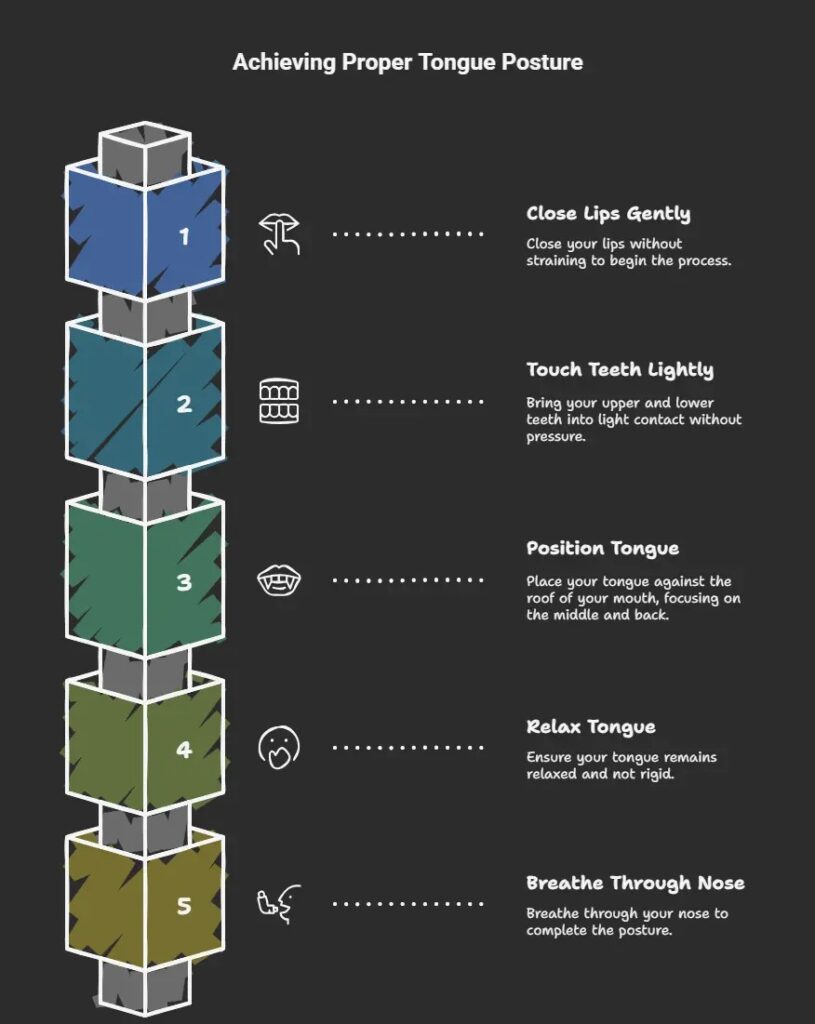
Step-by-step positioning:
- Close your lips gently, without straining.
- Gently bring your upper and lower teeth into contact without applying any pressure.
- Place your whole tongue, focusing on the middle and back portions, against the roof of your mouth and position it just behind the upper front teeth.
- Keep your tongue relaxed, not rigid.
- Breathe through your nose, not your mouth.
Importance of consistency:
Like any muscle habit, tongue posture becomes automatic with repetition. Consistently practicing throughout the day will build muscle memory, making the correct position your default even when you’re not thinking about it. Over time, you’ll enjoy the functional and subtle aesthetic benefits that come with a healthier oral posture.
Final Thoughts
Proper tongue posture is a small habit with surprisingly wide-reaching benefits for oral health, breathing, and overall comfort. For children and teens, it can play a meaningful role in guiding jaw and palate development, supporting bite alignment, and promoting healthy airway function. For adults, it’s more about maintaining function, reducing tension, and encouraging better muscle engagement than radically altering facial structure.
It’s important to remember that no posture technique mewing included can override genetics or remodel fully developed bones. Dramatic “jawline transformations” in adulthood are the exception, not the rule.
Instead, think of proper tongue posture as a complementary practice, a tool to support the work of orthodontics, myofunctional therapy, or simply your day-to-day health. It’s not a miracle fix, but it is a low-effort, no-cost habit that can pay off in subtle but meaningful ways over time.
FAQs
1. What is Tongue Posture?
Tongue posture describes the natural resting placement of the tongue within the mouth when an individual is neither speaking nor eating. In correct tongue posture, the tongue rests gently against the roof of the mouth, just behind the upper front teeth, while the lips remain closed and the teeth make light contact.
2. Can Tongue Posture Improve Jawline?
In children and adolescents, maintaining correct tongue posture can play a significant role in guiding the growth and development of the jaw and facial structure. In adults, bone structure is mostly fixed, so dramatic jawline changes are unlikely. However, it can improve muscle tone, reduce jaw tension, and support oral health.
3. What is mewing and how is it related to tongue posture?
Mewing is a technique that involves consciously keeping your tongue pressed against the roof of your mouth to encourage proper posture and improve facial appearance. While popular online, experts say its effects in adults are mostly functional, not structural.
4. How long does it take to see results from proper tongue posture?
For children, noticeable developmental benefits can occur over months to years. For adults, improvements in muscle tone and comfort may be noticed within weeks, but structural changes are minimal and occur slowly, if at all.
5. Is tongue posture part of myofunctional therapy?
Yes. Myofunctional therapy often includes tongue posture training along with exercises to improve breathing, swallowing, and oral muscle coordination. It’s used for both children (growth guidance) and adults (function and comfort).
6. Can poor tongue posture cause health problems?
Yes. Poor tongue posture can contribute to issues like crowded teeth, recessed jaw, mouth breathing, and even airway restrictions. Correcting it can help prevent or reduce these problems.
7. Are there risks to practicing tongue posture or mewing?
For most people, proper tongue posture is safe. However, over-pressing or straining the tongue can cause muscle fatigue or jaw discomfort. If you experience pain, consult a dentist, orthodontist, or myofunctional therapist.